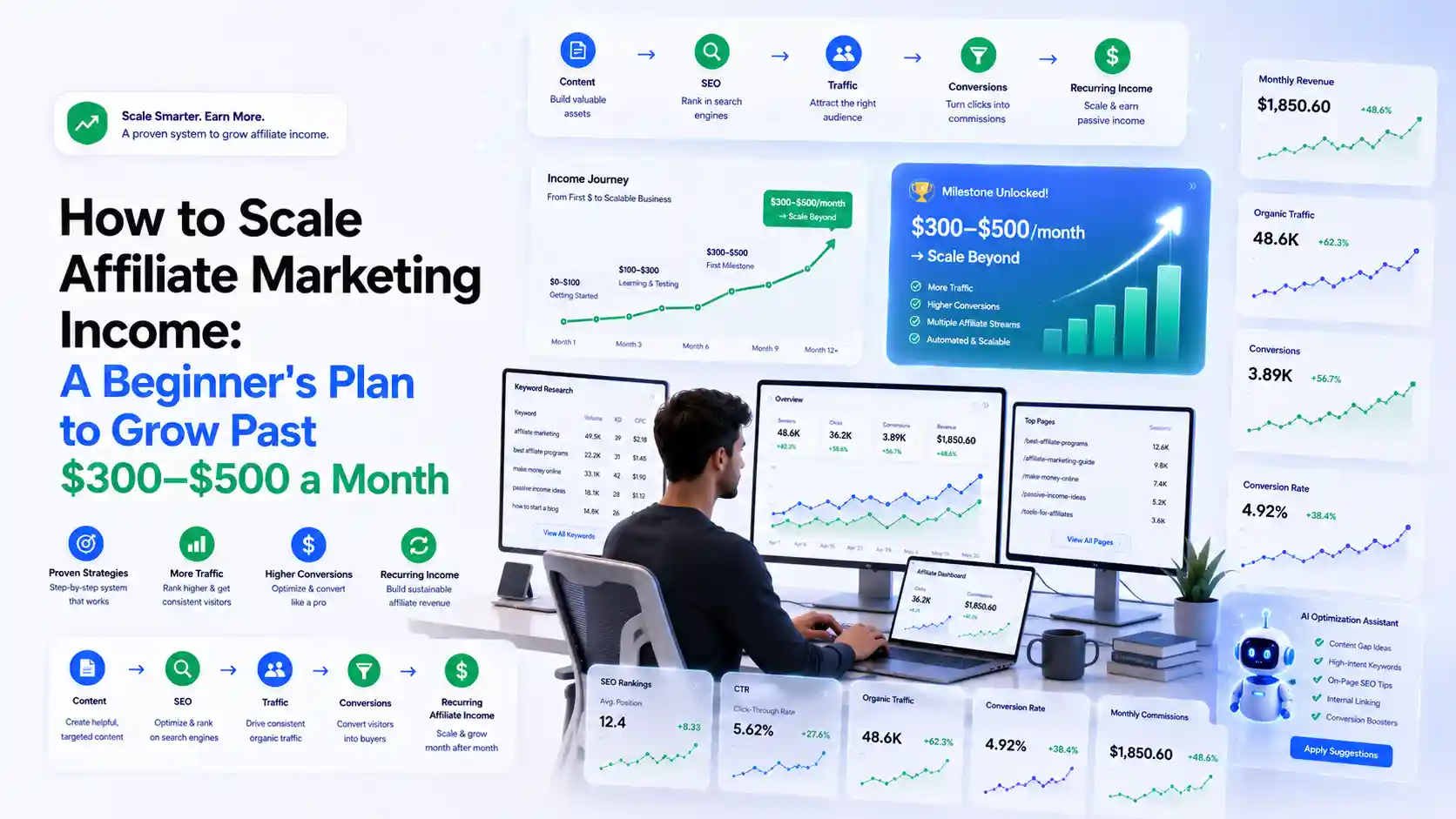
Making your first consistent affiliate commissions feels like a huge milestone — and it is. But a lot of beginners hit that point and then stall, unsure how to actually grow past it.
Scaling isn’t about working harder at the same things that got you your first sales. It’s a different phase with its own strategy.
This guide walks through exactly how to scale affiliate marketing income, with practical steps to grow affiliate income steadily and move realistically from side income to full time.
Uncover My Top Recommendation for Making $100-$300 Daily – Check Out This FREE Video to Begin >>>
What Does It Mean to Scale Affiliate Marketing Income?
Scaling affiliate marketing income means deliberately growing your existing results — not just repeating the same actions, but expanding what’s already working while removing what isn’t.
In practice, scaling usually involves a combination of:
- Doubling down on proven content and traffic sources, instead of spreading effort evenly across everything
- Diversifying traffic channels, so income isn’t dependent on a single platform or algorithm
- Improving conversion rates, so existing traffic earns more without needing to grow first
- Increasing earnings per sale, through better-paying programs or recurring commission products
- Adding leverage, through automation, systems, or outsourcing repetitive tasks
Scaling is less about starting new things and more about amplifying what your data already tells you is working.
Why Scaling Strategy Matters More Than Starting Strategy?
Many beginners assume the hardest part is getting started. In reality, the transition from a small side income to something more substantial requires a distinctly different mindset.
- Random effort stops working at scale. What got you your first sale rarely gets you your fiftieth without a more deliberate system behind it.
- Diversification protects your income. A single traffic source or single product can disappear overnight due to algorithm changes or program shutdowns, so growth without diversification is fragile.
- Data becomes more valuable as you grow. With more traffic and sales, your data gets statistically more reliable, making it a much stronger guide for decisions than it was when you were just starting out.
- Scaling well prevents burnout. Growing income without adding smarter systems often just means working more hours — a genuine scaling strategy replaces hustle with leverage.
Step-by-Step Guide: How to Grow Affiliate Income Strategically?
Once you’ve validated that something is working, follow this process to scale it deliberately.
Step 1: Identify What’s Actually Driving Results
Before scaling anything, review your data to find your best-performing content, products, and traffic sources. Scaling the wrong thing wastes time just as easily as scaling the right thing accelerates growth.
Step 2: Double Down Before Diversifying
Put more effort into your proven winners first — more content in a topic that’s converting, more promotion of a product that’s already selling — before spreading into entirely new areas.
Step 3: Add a Second Traffic Channel
Once your primary channel is stable, introduce a second one. If you’ve been relying on SEO, that might mean testing social content or email; if you’ve relied on social, that might mean building organic search traffic as a more durable long-term asset.
Step 4: Build an Email List as an Owned Asset
An email list gives you a direct line to your audience that isn’t dependent on any single platform’s algorithm. As you scale, this becomes one of your most valuable long-term growth levers.
Step 5: Seek Out Higher-Value Programs
As your traffic grows, look for affiliate programs offering better commission structures, recurring payments, or higher-ticket products that let your existing traffic earn more without requiring more visitors.
Step 6: Introduce Automation and Outsourcing
Identify repetitive tasks — scheduling content, basic editing, reporting — that can be automated or handed off, freeing up your time for the strategic decisions that actually move income forward.
Step 7: Reinvest Strategically
Once income is consistent, consider reinvesting a portion into tools, paid traffic tests on already-proven content, or outsourced help, rather than only reinvesting your time.
Uncover My Top Recommendation for Making $100-$300 Daily – Check Out This FREE Video to Begin >>>
Moving From Side Income to Full Time: What Realistically Changes
The jump from side income to full time isn’t just about hitting a bigger number — it’s about building a more resilient system.
At the side-income stage, a single traffic source and a handful of products can be enough. At the full-time stage, that same setup usually becomes too fragile, since your income now needs to reliably cover real expenses.
This is typically when diversifying traffic sources, adding recurring commission products, and building genuine systems around content and tracking becomes less optional and more essential.
A realistic affiliate income growth plan treats this transition as a deliberate phase, not an accident — meaning you build the systems for stability before you actually need to depend on the income, not after.
Common Mistakes When Trying to Scale Affiliate Income
- Scaling before validating what works. Pouring more effort into unproven content or products multiplies wasted time rather than results.
- Relying on a single traffic source indefinitely. This leaves your entire income exposed to one algorithm change or policy update.
- Chasing every new tactic instead of doubling down. Constantly switching strategies prevents any single one from fully compounding.
- Ignoring earnings per click or conversion data. Focusing only on traffic volume, without looking at what actually converts, can make growth look busier than it actually is profitable.
- Scaling without systems. Growing revenue without also growing your processes usually just means more hours worked, not more leverage gained.
Pro Tips for a Smarter Affiliate Income Growth Plan
Track earnings per click, not just commission percentage, since a lower percentage on a well-converting product can easily outperform a higher percentage on one that barely sells.
Test new traffic channels with your already-proven content first, rather than creating entirely new content for an unproven channel at the same time.
Set a specific reinvestment rule for yourself — for example, committing a percentage of new income toward tools, outsourcing, or testing — so scaling becomes a built-in habit rather than an afterthought.
Revisit your top-performing content and products quarterly, since what worked initially may need refreshing or replacing as trends and algorithms shift.
Finally, resist the urge to scale everything at once. Sequential, deliberate scaling — one channel, one system, one improvement at a time — tends to be far more sustainable than trying to grow every part of your business simultaneously.
FAQs
1. What does it mean to scale affiliate marketing income?
Scaling means deliberately growing your existing results by doubling down on what’s working, diversifying traffic sources, improving conversions, and adding systems or leverage rather than just working more hours.
2. What’s the best affiliate marketing scaling strategy for beginners?
Start by identifying your best-performing content and traffic source, invest more effort there first, then gradually diversify into a second channel and higher-value affiliate programs.
3. How do I grow affiliate income without burning out?
Focus on leverage rather than pure effort — automating repetitive tasks, outsourcing where possible, and reinvesting strategically instead of simply adding more hours to your workload.
4. How long does it take to go from side income to full time in affiliate marketing?
Timelines vary widely, but most affiliates report meaningful, more reliable income after several months to a year of consistent effort, with full-time income typically requiring a more diversified and systemized approach.
5. Should I diversify traffic sources before or after scaling?
Diversify once your primary channel is stable and consistently converting, since adding a second channel too early can spread effort thin before you’ve mastered the first one.
6. What’s the biggest mistake people make when trying to scale affiliate income?
Scaling effort into unproven content or products before validating what actually works is one of the most common and costly mistakes.
7. Do I need paid ads to scale affiliate marketing income?
No, though many affiliates eventually use paid ads to amplify already-proven organic content once they’ve validated what converts, rather than relying on paid traffic from the very beginning.
Uncover My Top Recommendation for Making $100-$300 Daily – Check Out This FREE Video to Begin >>>
Conclusion: Scale Deliberately, Not Just Harder
Growing affiliate income isn’t about repeating your early efforts louder — it’s about identifying what’s already working, diversifying strategically, and building systems that let your income grow without requiring endless additional hours.
Start by reviewing your data honestly, double down on your proven winners, and add one new channel or system at a time.
Ready to move from your first commissions to real, scalable income? Identify your top-performing content today, and build your next growth step around it instead of starting from scratch.