Most beginners make the same mistake: they jump straight into posting content, running ads, or pitching products — without a single framework to guide them. The result? Wasted time, wasted money ($50–$200 in ad spend gone), and zero results.
That’s exactly where the 3-3-3 rule in marketing comes in.
It’s one of the simplest, most actionable frameworks out there — and once you understand it, you’ll never approach your marketing the same way again. Whether you’re building a brand, growing a side hustle, or learning the craft for the first time, this guide will walk you through everything you need to know.
Let’s break it down
My Best Recommended & Proven Way to Make $50-$100 Daily – Watch This FREE Video to START >>>
What is the 3-3-3 Rule in Marketing?
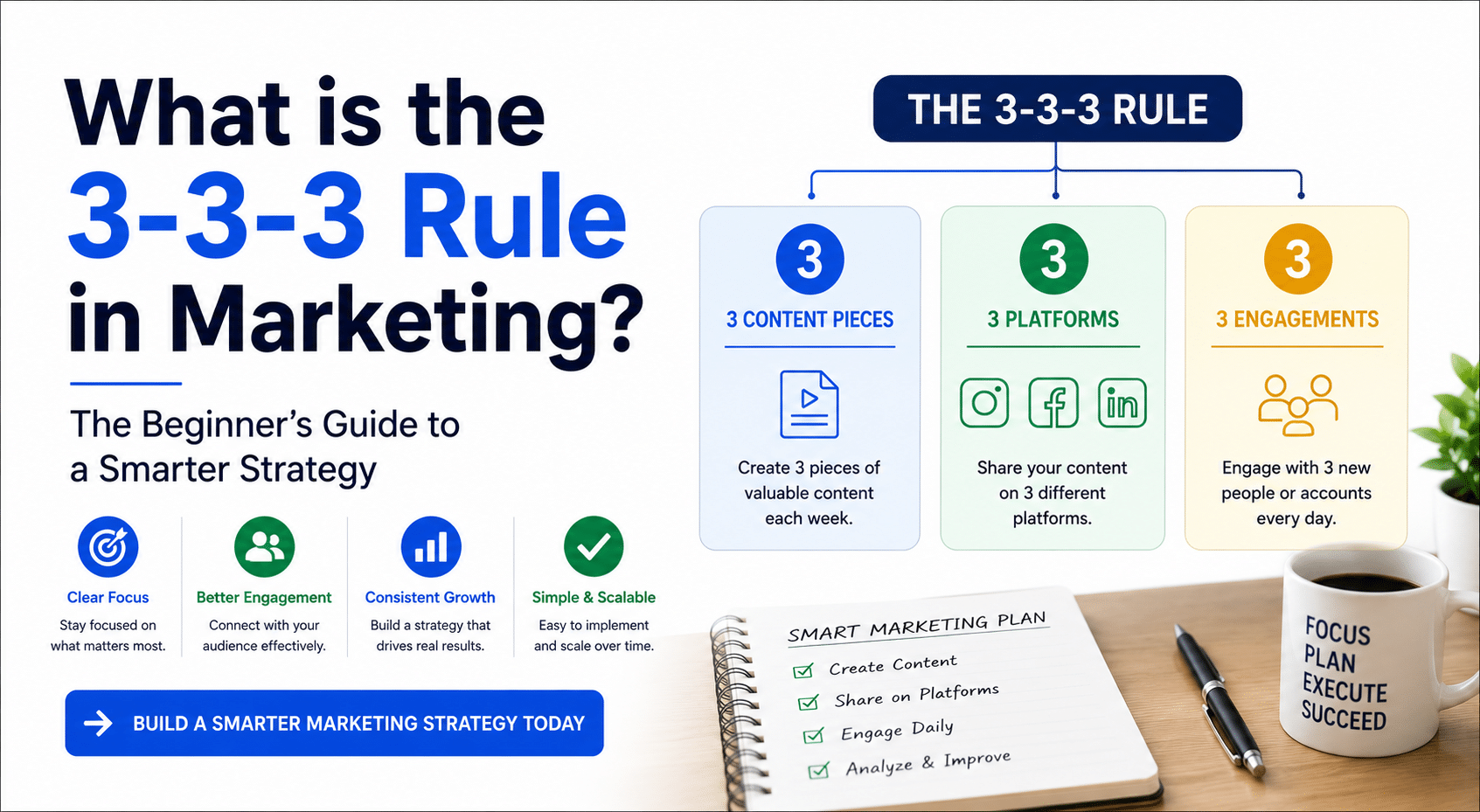
The 3-3-3 rule in marketing is a content and communication framework that helps marketers focus on the right audience, with the right message, at the right time — in three distinct steps.
Here’s the core idea:
3 seconds to grab attention → 3 minutes to build interest → 3 steps to drive action
Let’s unpack each layer:
1. The First 3 Seconds — Capture Attention
You have exactly 3 seconds (sometimes less) to stop someone from scrolling past your ad, post, or email subject line. If your hook isn’t compelling in those first 3 seconds, nothing else matters.
What works: bold visuals, a surprising stat, a relatable problem, or a direct question.
2. The Next 3 Minutes — Build Interest & Trust
Once you’ve earned attention, you have roughly 3 minutes to deliver value. This is where you explain, educate, or entertain. Think of it as your window to answer: “Why should I care about this?”
What works: storytelling, clear benefits, real examples, and social proof.
3. The Final 3 Steps — Drive Action
Every piece of marketing should lead somewhere. The 3-step action path keeps it simple:
- Step 1: Click / Engage
- Step 2: Learn more / Sign up
- Step 3: Buy / Convert
Remove friction. Make it obvious. Make it easy.
Why the 3-3-3 Rule in Marketing Matters?
Here’s the truth: most people consuming your content are distracted, skeptical, and busy.
The 3-3-3 rule works because it mirrors how the human brain actually processes information — in short bursts, followed by deeper engagement when interest is earned.
For beginners especially, this framework:
- Prevents “random posting” syndrome
- Saves money on ads that don’t convert
- Creates a repeatable system you can improve over time
- Builds real audience trust, not just vanity metrics
Shareable Insight: “Marketing isn’t about saying everything. It’s about saying the right thing at the right moment — the 3-3-3 rule gives you the timing.”
How the 3-3-3 Rule Connects to Other Frameworks?
You might be wondering: how does this fit with everything else I’m learning? Great question. Here’s how the 3-3-3 rule works alongside other popular marketing frameworks:
What are the 3 C’s and 4 P’s of Marketing?
The 3 C’s (Customer, Company, Competitor) help you define your marketing landscape. The 4 P’s (Product, Price, Place, Promotion) are your tactical tools. The 3-3-3 rule lives inside the Promotion pillar — it’s how you execute your messaging once the strategy is set.
What is the 70/20/10 Rule in Marketing?
The 70/20/10 rule guides your content mix:
- 70% proven, performing content
- 20% content that builds on what’s working
- 10% experimental, innovative content
The 3-3-3 rule applies to all three buckets — every piece of content still needs a hook, a value window, and a clear CTA.
What is the 4-1-1 Rule in Marketing?
The 4-1-1 rule (popularized for social media) says: for every 6 posts, share 4 educational posts, 1 soft pitch, and 1 direct promotion. The 3-3-3 rule is how you structure each of those posts.
What is the 3-3-3 Rule in Sales?
In sales, the 3-3-3 rule often means: reach out to 3 prospects, using 3 different channels, over 3 consecutive days. It’s a follow-up cadence that keeps outreach consistent without being spammy. The marketing version and sales version share the same philosophy: persistence + structure = results.
What are the 7 Pillars of Marketing?
The 7 pillars — Product, Price, Place, Promotion, People, Process, and Physical Evidence — form the complete marketing mix. The 3-3-3 rule is a tool used primarily within Promotion and People, helping you communicate the right way to the right humans.
My Best Recommended & Proven Way to Make $50-$100 Daily – Watch This FREE Video to START >>>
Step-by-Step: How to Apply the 3-3-3 Rule Right Now
Ready to put this into practice? Here’s a beginner-friendly guide:
Step 1: Write a killer hook (for your 3-second window) Start every piece of content — email, ad, post, reel — with a single sentence that creates curiosity or speaks to a pain point. Example: “You’re losing customers in the first 3 seconds and you don’t even know it.”
Step 2: Deliver clear value (for your 3-minute window) In the body of your content, answer ONE question well. Don’t try to cover everything. Use short paragraphs, bullet points, and relatable examples. Teach something real.
Step 3: End with a simple 3-step action path Tell your audience exactly what to do next. Don’t leave them guessing. Example: “Like this post → Follow for more → DM me the word ‘GUIDE’ for a free resource.”
Step 4: Review and repeat After 7 days, check: Did people stop scrolling (engagement rate)? Did they spend time (watch time, read time)? Did they act (clicks, sign-ups)? Improve the weakest step.
Common Mistakes Beginners Make with the 3-3-3 Rule
Skipping the hook — jumping straight into information without earning attention first.
Overloading the value section — trying to say everything in one post. Pick one idea and nail it.
Weak or missing CTA — ending content with “hope this helps!” instead of a clear next step.
Inconsistency — using the framework once and giving up. The power comes from repetition.
Ignoring the audience — writing content you find interesting instead of content they need.
Pro Tips & Advanced Insights
Layer the frameworks. Use the 70/20/10 rule to plan your content calendar, the 4-1-1 rule to balance your posts, and the 3-3-3 rule to write every single one. They’re not competing — they’re complementary.
Test your 3-second hook first. Before spending $50–$100 on ads, post the content organically. If real people don’t engage, the paid version won’t fix a broken hook.
Use the 3-step action path as a sales funnel in miniature. Each step maps to Awareness → Consideration → Conversion. Even a single Instagram post can move someone through all three if it’s built right.
Apply the 3-3-3 rule in sales outreach too. Three touchpoints, three channels, three days. It’s simple, trackable, and surprisingly effective for early-stage businesses.
My Best Recommended & Proven Way to Make $50-$100 Daily – Watch This FREE Video to START >>>
FAQs About the 3-3-3 Rule in Marketing
What is the 3-3-3 rule in marketing, simply explained?
The 3-3-3 rule is a content framework: use the first 3 seconds to grab attention, the next 3 minutes to deliver value, and 3 clear steps to drive action. It helps beginners create focused, effective marketing content.
Is the 3-3-3 rule the same in marketing and sales?
Not exactly. In marketing, it’s about content structure and timing. In sales, the 3-3-3 rule typically refers to contacting 3 prospects across 3 channels over 3 days. Both share the principle of structured, intentional outreach.
How does the 3-3-3 rule relate to the 4 P’s of marketing?
The 3-3-3 rule operates within the “Promotion” P. Once you’ve defined your product, pricing, and distribution, the 3-3-3 rule guides how you communicate it to your audience.
Can beginners use the 3-3-3 rule without a big budget?
Absolutely. The framework costs $0 to implement. It’s a thinking and writing tool, not a paid platform. You can apply it to free posts, emails, or videos before spending a single dollar on ads.
How does the 3-3-3 rule work with the 70/20/10 rule?
Use 70/20/10 to decide what content to create (proven vs. new vs. experimental). Then use the 3-3-3 rule to structure how you write or produce each piece of content.
What are the 7 pillars of marketing and where does the 3-3-3 rule fit?
The 7 pillars are Product, Price, Place, Promotion, People, Process, and Physical Evidence. The 3-3-3 rule is primarily a tool for Promotion — helping you craft messages that resonate with People.
How long does it take to see results with the 3-3-3 rule?
Most beginners see improved engagement within 2–4 weeks of consistent application. It’s not a magic trick — it’s a repeatable system that compounds over time.
Conclusion: Start Simple, Start Now
If you’re new to marketing, the worst thing you can do is try to learn everything at once. Start here: 3 seconds, 3 minutes, 3 steps.
The 3-3-3 rule in marketing isn’t flashy, but it works. It helps you stop guessing and start building a real system — one that saves you money, grows your audience, and turns strangers into customers.
You don’t need a $200 course. You don’t need a massive ad budget. You need a framework, the discipline to apply it, and the patience to improve.