If you’ve ever launched a campaign with high hopes only to watch it underperform, you’re not alone. The most common reason isn’t bad creative, bad timing, or even a bad product — it’s trying to say too much, to too many people, in too many places at once.
That’s exactly the problem the 3-3-3 rule for marketing was built to solve. It’s one of the simplest, most effective frameworks in modern marketing — and it works whether you’re a solo founder, a content creator, or a Fortune 500 brand.
In this guide, you’ll learn exactly what the 3-3-3 rule is, why it works so well, and how to apply it to your business this week.
My Best Recommended & Proven Way to Make $50-$100 Daily – Watch This FREE Video to START >>>
What Is the 3-3-3 Rule for Marketing?
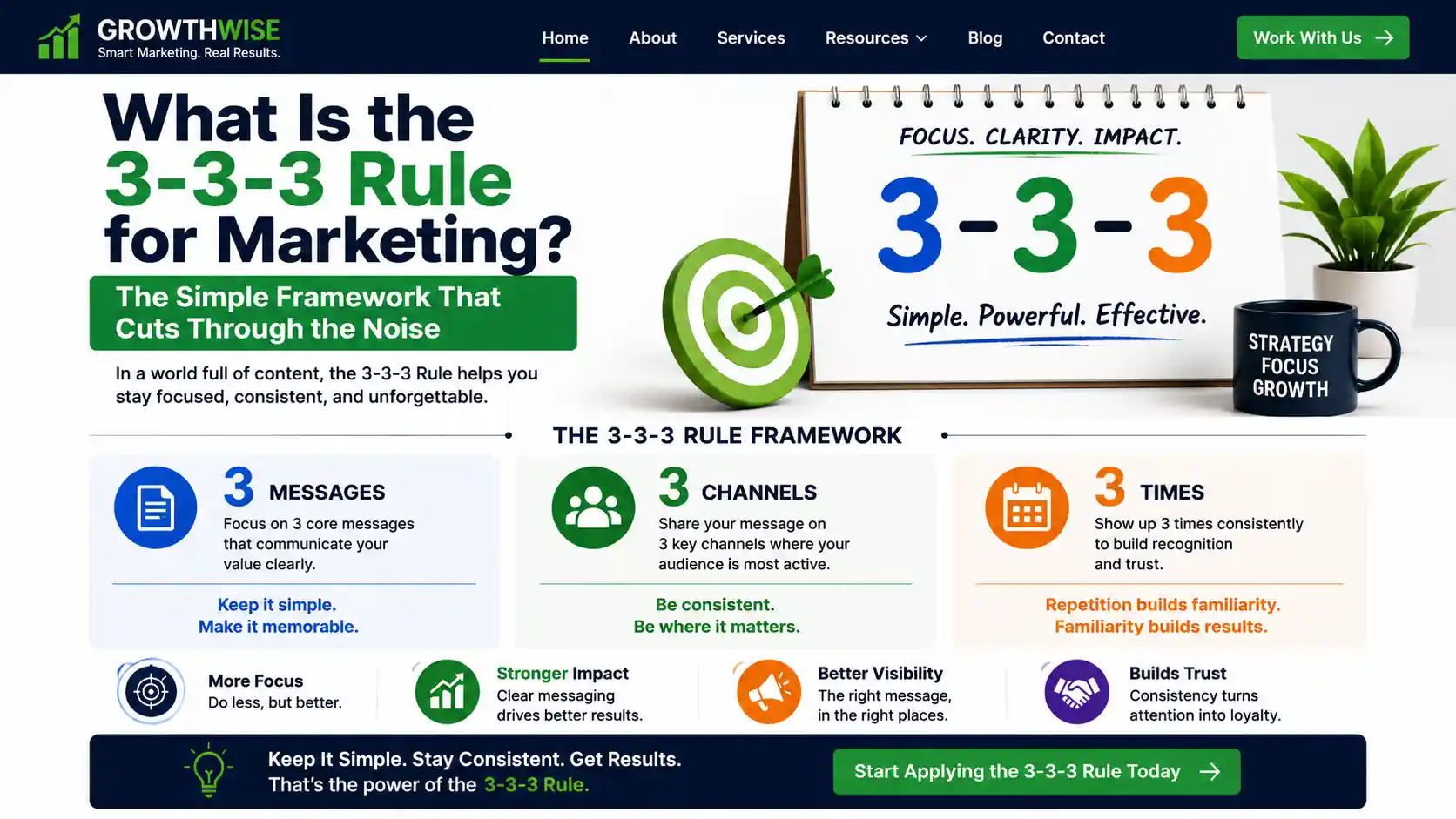
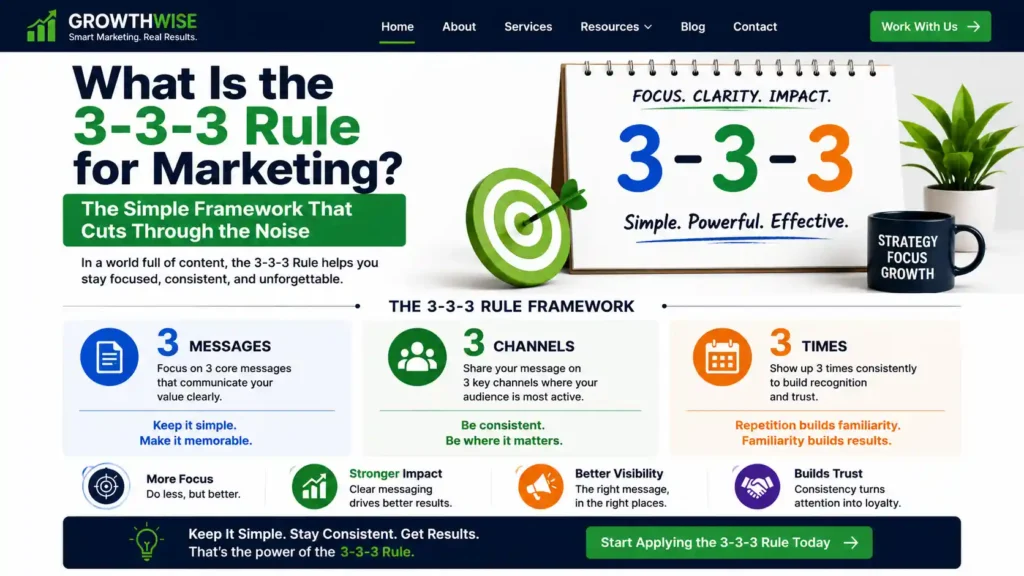
The 3-3-3 rule for marketing is a strategic framework that focuses your campaigns around 3 core messages, 3 audience segments, and 3 primary marketing channels. Instead of trying to communicate everything to everyone, you concentrate your effort on a focused set of nine intersections — and reinforce them consistently.
Here’s the structure in one line:
3 messages × 3 audiences × 3 channels = clarity, recall, and conversion.
The rule comes from a fundamental truth about human attention: consumers see thousands of marketing messages every day. The brands that win aren’t the loudest — they’re the clearest and most consistent.
Key insight: The 3-3-3 rule isn’t about saying less. It’s about saying the right things, to the right people, in the right places — and saying them often enough to be remembered.
Why the 3-3-3 Rule Matters in 2026
In a world of TikTok, Reels, AI-generated content, and 8-second attention spans, focus has become the rarest skill in marketing. The 3-3-3 rule matters because:
- It forces clarity. You can’t fake focus. Choosing only 3 of each forces tough but valuable decisions.
- It improves recall. Repetition across consistent channels makes your brand stick in memory.
- It saves budget. Most marketing waste comes from spreading too thin. The 3-3-3 rule eliminates that.
- It scales easily. Once a 3-3-3 campaign works, you can scale spend confidently — because you know what’s working.
- It’s beginner-friendly. No MBA required. A solo founder can apply it in an afternoon.
Brands that apply the 3-3-3 rule consistently often see 2–3x improvements in marketing ROI within 60–90 days.
The 3-3-3 Rule Broken Down
| Element | What It Means | Example |
|---|---|---|
| 3 Messages | The 3 most important benefits or value propositions of your brand | “Save time”, “Save money”, “Reduce stress” |
| 3 Audiences | The 3 most valuable customer segments you want to reach | Solo founders, small agencies, freelancers |
| 3 Channels | The 3 platforms where your audience spends real time | Instagram, LinkedIn, Email |
When done right, every marketing asset you create maps to one message, one audience, one channel — making your campaigns sharp, traceable, and measurable.
My Best Recommended & Proven Way to Make $50-$100 Daily – Watch This FREE Video to START >>>
How to Apply the 3-3-3 Rule Step-by-Step?
Here’s the exact process for building your first 3-3-3 marketing plan.
Step 1: Identify Your 3 Core Messages
Ask yourself: “What are the 3 biggest reasons someone should choose us over anyone else?”
Stick to benefits, not features. “Built with AI” is a feature. “Cuts your reporting time in half” is a benefit.
- Example for a productivity app: 1) Save 5 hours a week, 2) Replace 4 tools with one, 3) Works without setup
- Pro tip: If you can’t list 3 sharp benefits in 60 seconds, your positioning needs work before your marketing does.
Step 2: Define Your 3 Audience Segments
Don’t say “everyone.” Pick the 3 most valuable customer types based on revenue, urgency of pain, or ease of conversion.
- Example for the same productivity app: 1) Solo freelancers, 2) Small agency owners, 3) Remote teams of 5–20
- Pro tip: For each audience, write down their #1 pain point, #1 objection, and where they hang out online.
Step 3: Choose Your 3 Primary Marketing Channels
The right channels are the ones where your specific audience is already paying attention. Not where you’re comfortable.
- Common high-performing channel combos:
- B2B: LinkedIn, email newsletter, SEO blog
- B2C/lifestyle: Instagram, TikTok, Pinterest
- Local business: Google Maps, Facebook, WhatsApp
- Creators: YouTube, email list, Twitter/X
- Pro tip: Pick channels you can be consistent on for 90+ days. Three channels done well beats nine done badly.
Step 4: Map Messages to Audiences to Channels
Now build your matrix. Every campaign asset should know exactly which message, audience, and channel it belongs to.
- Example asset: A LinkedIn post about “Save 5 hours a week” → targeted at “Solo freelancers” → published on “LinkedIn.”
This single matrix eliminates 80% of confused, unfocused marketing.
Step 5: Reinforce Consistently for 90 Days
The magic of the 3-3-3 rule isn’t in the plan — it’s in the repetition. Run the same 3 messages, to the same 3 audiences, across the same 3 channels, for at least 90 days before evaluating.
Most brands quit on a working strategy at day 30. Don’t.
Step 6: Measure and Optimize
After 90 days, look at your data:
- Which message converted best?
- Which audience showed the highest lifetime value?
- Which channel produced the lowest cost per result?
Double down on the winners. Replace the weakest of each three with the next-best candidate. Then run another 90-day cycle.
Real-World Example of the 3-3-3 Rule in Action
Let’s say you’re a freelance web designer.
3 Messages:
- “Launch your site in 2 weeks, not 2 months”
- “Designs that actually convert visitors into clients”
- “Fixed-price packages — no surprise invoices”
3 Audiences:
- Coaches and consultants
- Small e-commerce store owners
- Local service businesses (dentists, gyms, restaurants)
3 Channels:
- LinkedIn (posts + DMs)
- Instagram (portfolio carousels)
- Email newsletter (case studies)
Now every post, every email, every DM has a clear home. No more “What should I post about today?” paralysis — and no more wasted creative energy.
Common Mistakes to Avoid
- Choosing 5–6 messages instead of 3. “Just one more” kills the framework. Discipline matters here.
- Picking channels you like instead of where your audience is. You’re not the audience. Go where they actually scroll.
- Switching messages every week. Consistency is the entire point. Stick with the same 3 for 90 days minimum.
- Targeting “everyone” because you’re afraid to niche down. Vague targeting equals vague results. Specific beats broad every time.
- Forgetting to map content to one of the 9 intersections. Every asset should answer: “Which message? Which audience? Which channel?”
Pro Tips for Advanced Marketers
- Use the 3-3-3 rule for paid ads too. Run 3 ad creatives × 3 audience targets × 3 platforms. Cleanest A/B testing structure you’ll ever build.
- Repurpose one asset across all 3 channels. A LinkedIn post → Instagram carousel → email newsletter. Triple the reach, one-third the effort.
- Pair the 3-3-3 rule with the “Rule of 7.” Prospects need to see your message 7 times before acting. The 3-3-3 framework ensures those 7 touches stay consistent.
- Use AI tools to scale your 3-3-3 plan. Tools like ChatGPT and Claude can help generate 30 variations of each message — but the framework keeps every variation on-brand.
- Audit your old marketing through the 3-3-3 lens. Look at your last 3 months of content. How many clearly map to one message, one audience, one channel? That number is your focus problem.
Shareable Insights (For LinkedIn, Twitter & Medium)
Insight 1 (LinkedIn): “The 3-3-3 rule isn’t a marketing tactic. It’s a discipline. Three messages, three audiences, three channels — and the courage to ignore everything else for 90 days. That’s where ROI hides.”
Insight 2 (Twitter/X): “Most marketing fails because brands try to say everything to everyone. The 3-3-3 rule forces focus: 3 messages × 3 audiences × 3 channels. Try it for 90 days. Watch what happens.”
Insight 3 (Medium): “Marketing complexity is a confidence problem. The brands willing to say only three things, to only three people, in only three places — those are the brands that get remembered.”
My Best Recommended & Proven Way to Make $50-$100 Daily – Watch This FREE Video to START >>>
Frequently Asked Questions
What is the 3-3-3 rule for marketing in simple terms?
The 3-3-3 rule for marketing is a framework that focuses your campaigns on 3 core messages, 3 audience segments, and 3 primary marketing channels. Instead of spreading thin, you concentrate effort for clarity, recall, and higher ROI.
Where did the 3-3-3 rule for marketing come from?
The 3-3-3 rule emerged from modern marketing practice as a response to information overload and shrinking attention spans. It builds on classic principles like the Rule of Three (in copywriting) and the Rule of 7 (in advertising frequency), but applies them to a complete campaign strategy.
Does the 3-3-3 rule work for small businesses and beginners?
Yes — arguably better than for large brands. Small businesses have limited time, budget, and team. The 3-3-3 rule forces the focus that small businesses need to compete with bigger competitors who waste money trying to be everywhere.
How long does it take to see results from the 3-3-3 rule?
Most brands see noticeable improvements within 60–90 days of consistent application. Expect 2–3x ROI improvements in many cases — but only if you commit to the full 90-day cycle without switching the 3 messages midway.
Can the 3-3-3 rule be used with paid advertising?
Absolutely. In fact, it’s one of the cleanest structures for paid ads: run 3 creatives × 3 audience targets × 3 platforms. This gives you 27 data points to analyze, making A/B testing dramatically more reliable.
What’s the difference between the 3-3-3 rule and the Rule of Three?
The Rule of Three is a copywriting principle — that ideas presented in threes are more persuasive (“Stop, drop, and roll”). The 3-3-3 rule is a campaign framework — 3 messages × 3 audiences × 3 channels. They pair beautifully: use 3-3-3 for strategy and Rule of Three for copy.
How do I choose which 3 messages to focus on?
Start with your 3 biggest customer benefits — not features. Talk to your top 5 customers and ask: “What problem did we solve for you, and what would have happened if we hadn’t?” The patterns in their answers will reveal your strongest 3 messages.
Conclusion: Less Is the New More
The 3-3-3 rule for marketing isn’t revolutionary — it’s just disciplined. And in a marketing world that rewards loud, frantic, do-everything strategies, discipline is the real competitive edge.
Three messages. Three audiences. Three channels. Ninety days of consistent execution.
That’s it. That’s the entire framework that helps small brands beat huge budgets and helps experienced marketers cut through the noise of an overcrowded digital world.
If your marketing has felt scattered, expensive, or unmemorable lately, the 3-3-3 rule is your reset button.