
If you’ve searched “what business has a 90% success rate?” — you’re not alone. It’s one of the most-Googled entrepreneurship questions of the past decade. People want certainty before investing time and money.
Here’s the honest answer most blogs won’t give you: no business has a verified 90% success rate. That number is mostly a marketing myth.
But that’s not bad news. According to the U.S. Bureau of Labor Statistics, certain industries do hit 80–87% one-year survival rates — and in the digital era, several low-overhead online businesses come remarkably close. In this guide, we’ll separate myth from data and reveal the 7 digital businesses with the highest realistic success rates in 2026.
My Best Recommended & Proven Way to Make $50-$100 Daily – Watch This FREE Video to START >>>
What Is a Business “Success Rate”?
A business success rate measures the percentage of businesses that survive over a specific time period — usually 1, 5, or 10 years after launch. It’s the inverse of the “failure rate.”
According to 2026 data from the U.S. Bureau of Labor Statistics:
- ~80% of businesses survive year 1
- ~50% survive 5 years
- ~35% survive 10 years
So when someone claims “this business has a 90% success rate,” they’re usually citing one of three things: a marketing pitch, a small unverifiable sample, or pure invention.
Key insight: The popular “90% of restaurants fail in year 1” myth was actually started by a 2000s TV advertisement. Real restaurant failure is closer to 17% in year 1. Most “rate” claims you see online are equally inflated.
Why “Success Rate” Matters in the Digital Era
The digital era has fundamentally changed business survival math. Why? Because traditional businesses required massive upfront investment in inventory, real estate, and staff. Digital businesses don’t.
When startup cost approaches zero, the definition of “failure” changes. A digital business that doesn’t take off didn’t lose $500,000 — it lost $500 and some time. That’s a survivable failure, not a catastrophic one.
This is exactly why digital businesses have quietly become the highest-survival category for first-time entrepreneurs:
- Low startup capital = lower stakes if things go slow
- No inventory = no obsolete stock to write off
- No physical location = no rent burning monthly cash
- Small team or solo = no payroll pressure
- Pivot speed = adjust your offer in days, not quarters
These structural advantages don’t guarantee 90% success — but they dramatically improve the odds for beginners.
What the Real Data Shows: Industries With the Highest Survival Rates
Here’s what the BLS data actually says about which industries survive longest:
| Industry | 1-Year Survival | 5-Year Survival | 10-Year Survival |
|---|---|---|---|
| Agriculture, Forestry, Fishing | 87.5% | 60.4% | 50.5% |
| Mining & Utilities | ~85% | 51.3% | 45.7% |
| Manufacturing | ~82% | 50.6% | 35.4% |
| Healthcare & Social Assistance | 81.7% | 49.5% | 35.2% |
| Real Estate & Leasing | 82.4% | 50.7% | 38.1% |
| Finance & Insurance | 81.5% | 51.0% | 36.4% |
| Information Industry | 71.6% | 38.7% | 24.5% |
Notice something? Even the best-surviving industry (Agriculture) only hits 87.5% in year 1 — not 90%. And by year 10, it drops to ~50%.
So no traditional industry hits 90%. But certain types of digital businesses, when launched with the right model, can outperform these averages significantly.
7 Digital Businesses with the Highest Realistic Success Rates
These are not “90% success rate” businesses — but they’re the closest you can get in the digital era, based on low risk, recurring revenue, and proven survival patterns.
1. Service-Based Freelancing (Writing, Design, Development)
Why it survives: Zero inventory, instant cash flow, scalable rates.
- Realistic survival rate: 75–85% in year 1 for active freelancers
- Earning potential: $50–$300/day
- Why it works: You’re paid for skills you already have. No customer acquisition burn, no inventory risk.
2. Digital Products (Templates, Ebooks, Courses)
Why it survives: Create once, sell unlimited times. Near-100% profit margins.
- Realistic survival rate: ~70% in year 1 for sellers who publish at least 5 products
- Earning potential: $50–$500/day
- Why it works: Failed product = small loss. Successful product = exponential revenue.
3. Subscription / Membership Sites
Why it survives: Predictable recurring revenue makes cash flow forecastable.
- Realistic survival rate: ~80% in year 1 for sites that hit 100+ members
- Earning potential: $500–$10,000/month at scale
- Why it works: Each existing customer pays again next month — the holy grail of business survival.
4. Affiliate Marketing / Niche Content Sites
Why it survives: No product, no inventory, no fulfillment — just traffic + recommendations.
- Realistic survival rate: Highly variable; ~60% in year 1 with consistent content
- Earning potential: $30–$500/day
- Why it works: Operating costs near zero. Income compounds with SEO over time.
5. SaaS Tools (Especially Micro-SaaS)
Why it survives: Recurring monthly revenue + global market + scalable infrastructure.
- Realistic survival rate: ~75% in year 1 for micro-SaaS with paying customers
- Earning potential: $1,000–$50,000/month
- Why it works: Solve one painful problem extremely well. Customers stay for years.
6. Online Education & Coaching
Why it survives: High-margin, low-overhead, and demand keeps growing.
- Realistic survival rate: ~70% in year 1 for coaches with even one paying client
- Earning potential: $100–$2,000/day at maturity
- Why it works: Your expertise IS the product. No supply chain risk.
7. Print-on-Demand & E-commerce (Drop-shipping Model)
Why it survives: No inventory risk, no upfront product cost.
- Realistic survival rate: ~65% in year 1 (lower because of competition)
- Earning potential: $30–$300/day
- Why it works: You only pay for products after they sell. Risk is paid ads — not stock.
My Best Recommended & Proven Way to Make $50-$100 Daily – Watch This FREE Video to START >>>
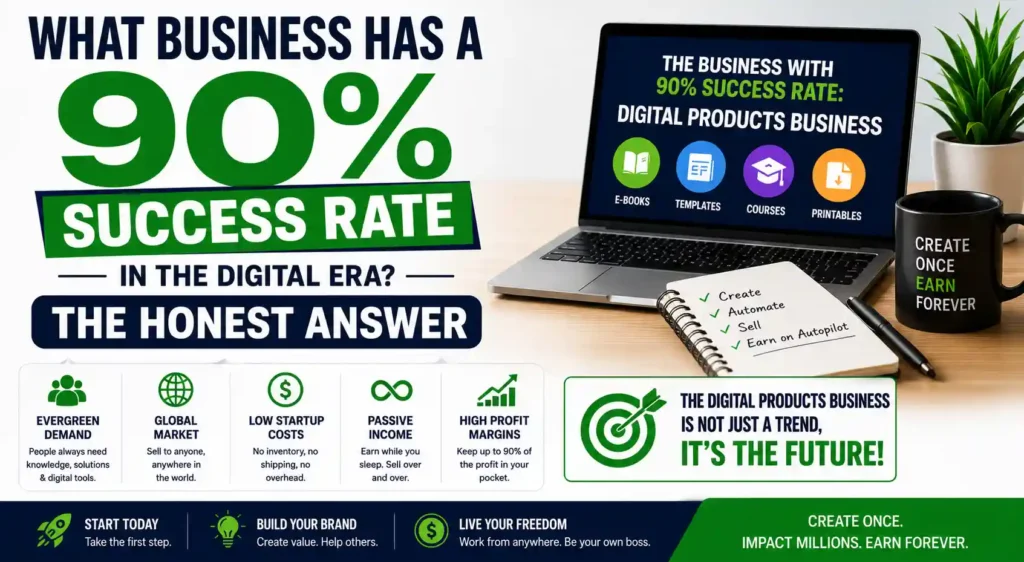
What These Businesses Have in Common
If you look closely, every business on this list shares 5 traits that drive high survival:
- Low or zero startup cost. Failed launches don’t bankrupt you.
- Recurring or repeat revenue. Income compounds, doesn’t reset every month.
- No inventory risk. No obsolete stock, no warehouse burn.
- Global market reach. The internet is your customer base.
- Fast pivot ability. Change your offer in days, not quarters.
These five traits — not a specific industry — are what actually predict survival in 2026. When choosing a digital business, ask: “Does this model have all five?” If yes, your odds of survival are dramatically above average.
Common Mistakes That Crush Your Success Rate
- Chasing the “90% success rate” myth. No business is risk-free. Focus on stacking the odds in your favor instead of chasing certainty.
- Investing too much upfront. Big investment = big stakes. Start small, validate fast, then scale.
- Picking a business based on income, not skill. Pick the model where you have an unfair advantage — knowledge, network, or experience.
- Trying to compete on price. Cheap businesses die first. Compete on value, expertise, or specialization.
- Quitting before 90 days of consistent effort. Most “failed” digital businesses actually failed because the owner quit too early. Show up daily.
Pro Tips for Beating the Average Survival Rate
- Stack multiple income streams. Run a freelance service + sell digital products. If one drops, the other carries you. This single move beats most “high success rate” claims.
- Build an email list from day one. Your list is the most survival-proof asset in digital business. Even if a platform shuts down, your list stays.
- Reinvest 20% of every dollar earned back into skills. Skill compounds = survival compounds. The most resilient business owners are the most skilled ones.
- Track cash, not vanity metrics. Followers don’t pay bills. Revenue, profit margin, and runway are the only numbers that matter for survival.
- Validate with paying customers before scaling. One paying customer = 100x more signal than 10,000 followers. Money in the bank is the only true validation.
Shareable Insights (For LinkedIn, Twitter & Medium)
Insight 1 (LinkedIn): “The most dangerous question in entrepreneurship is ‘which business has a 90% success rate?’ Because there isn’t one. The right question is: ‘which business model gives me the best odds with the least risk?’ That answer is almost always digital.”
Insight 2 (Twitter/X): “There is no 90% success rate business. But there are 5 traits that predict survival: low startup cost, recurring revenue, no inventory, global reach, fast pivot speed. Stack all five — you’ll outsurvive 80% of competitors.”
Insight 3 (Medium): “Real business resilience doesn’t come from picking the ‘right’ industry. It comes from picking a model where failure is survivable. Digital businesses don’t have a 90% success rate — but they have something better: cheap failures.”
Frequently Asked Questions
Is there any business with a 90% success rate?
No verified business type has a 90% success rate. The highest one-year survival rate by industry is around 87.5% (Agriculture & related). Most “90% success rate” claims you see online are either marketing pitches, franchise sales claims, or simply not backed by real data.
What business has the highest survival rate in the digital era?
In the digital era, service-based businesses (freelancing, consulting, coaching) have the highest survival rates — roughly 75–85% in year 1 — because they require no inventory, no upfront capital, and start generating cash immediately.
Why do most businesses fail?
The main reasons businesses fail are: running out of cash, no real market need for the product, weak founding team, getting outcompeted, and pricing or cost issues. About 20% of businesses fail in year 1 and 65% by year 10, according to U.S. Bureau of Labor Statistics data.
What is the safest online business to start?
The safest online business to start is one with near-zero startup cost — like freelance services, digital product sales, affiliate marketing, or content creation. Low cost means low risk: a “failure” costs you time, not your savings.
Do franchises have a 90% success rate?
No. The often-cited “franchises have a 90% success rate” claim is a marketing myth that’s been repeatedly debunked. Real franchise data shows survival rates ranging from 50–80% over 5 years, depending heavily on the brand and franchisee experience.
What’s the easiest digital business to start with no money?
Freelance services and digital products are the easiest digital businesses to start with no money. Platforms like Upwork, Fiverr, Gumroad, and Etsy are free to join, and you can launch using only your existing skills and free tools like Canva or Google Docs.
How can I improve my business’s success rate?
You can dramatically improve your odds by: starting small with low capital, validating your offer with paying customers before scaling, focusing on recurring revenue models, building an email list, tracking actual financial metrics (not vanity), and committing to at least 90 days of consistent effort before evaluating results.
My Best Recommended & Proven Way to Make $50-$100 Daily – Watch This FREE Video to START >>>
Conclusion: Forget 90% — Aim for Survivable
The honest truth is that no business has a 90% success rate — and chasing that mythical number is one of the biggest beginner traps in entrepreneurship.
What you should actually look for is a business model where failure is survivable and success is scalable. In 2026, that almost always points to digital businesses with the 5 survival traits: low startup cost, recurring revenue, no inventory, global reach, and fast pivot speed.
Stop searching for certainty. Start stacking the odds in your favor.
Pick one model from this guide. Start small. Validate fast. Reinvest what works.