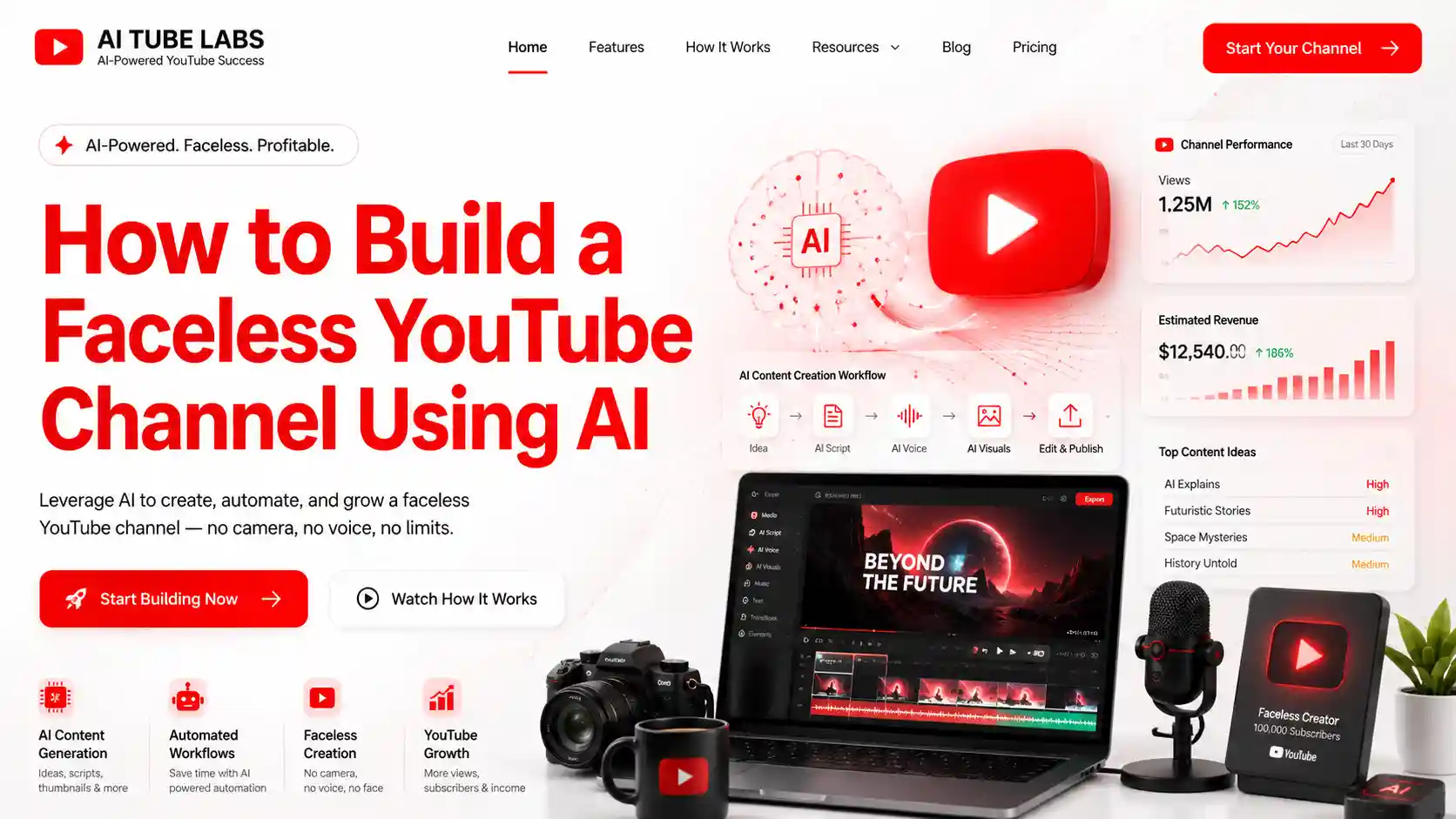
Building a faceless YouTube channel using AI takes 7 steps, about $50 per month in tools, and one thing no software sells you: a human point of view.
The camera stays in the drawer. Your voice, your research, and your opinions still have to show up on screen.
The timing looks strange at first glance. Faceless channels now make up 38% of all new creator monetization ventures, up from 12% in 2022, according to reporting from Bottle Rocket Content.
In one January 2026 sweep, YouTube permanently removed 16 AI-driven channels holding 4.7 billion views and 35 million subscribers.
Both numbers are true, and the gap between them is the whole strategy.
This guide covers what a faceless AI channel is, the 3 rules that decide whether you get paid, the 5 best faceless niches, the 4 tools worth buying, and the 7 steps to your first payout.
Uncover My Top Recommendation for Making $300-$400 Daily – Check Out This FREE Video to Begin >>>
What Is a Faceless YouTube Channel?
A faceless YouTube channel is a channel that publishes videos without showing the creator on camera, using voiceover, screen recordings, animation, stock footage, or AI visuals instead.
Your identity stays private. Your editorial judgment does not.
AI enters the process at 4 points:
- Research and scripting. Tools such as ChatGPT and Claude draft outlines, hooks, and first-pass scripts.
- Voice. Tools such as ElevenLabs generate narration, or clone your own voice for consistency across uploads.
- Visuals. Tools such as Runway, Canva, and Veo produce b-roll, motion graphics, and thumbnails.
- Editing. Tools such as Descript and CapCut cut the video from the transcript rather than the timeline.
That stack produces a video for under $3 in production cost, which explains why the format scaled so fast, and why YouTube started paying attention.
Why It Matters in 2026: The 3 Rules That Decide Your Income
AI does not get a faceless channel demonetized. Mass-produced content does. In July 2025 YouTube renamed its “repetitious content” guideline to the inauthentic content policy, and the scope widened from spam detection to any channel built on templates, recycled clips, or scripts read out word for word.
The January 2026 wave hit channels sharing one profile: synthetic voiceover, stock footage, templated scripts, and volume-based upload schedules. Roughly $10 million in annual ad revenue vanished with them.
Follow these 3 rules and your channel stays on the paying side of the line:
- Disclose realistic synthetic content with the “altered or synthetic content” toggle in YouTube Studio. The disclosure costs $0 and hides nothing worth hiding.
- Rewrite at least 40% of every AI draft, so a real opinion, a real comparison, or a real story sits inside the video.
- Vary your uploads. Ask 1 question about each video: could another channel recreate this in an afternoon? A yes puts you in the risk zone.
Viewers back the policy with their attention. Only 26% of consumers now prefer generative AI creator content over human creator content, down from 60% in 2023, per research from Billion Dollar Boy. Sounding human is no longer a nice touch, it is the business model.
5 Best Faceless YouTube Niches for Beginners
These 5 niches pair strong advertiser demand with content a researcher covers better than a performer.
- Personal finance and investing. Advertisers pay the highest rates in this category, and charts, screen recordings, and calm narration carry the video. Your edge comes from running real numbers, not reciting definitions.
- Software and AI tutorials. Screen recordings fill the frame, and viewers search these keywords with a credit card open. Affiliate income often beats ad income here by 3 to 5 times.
- History and documentary storytelling. Long scripts, archival images, and a strong narrative voice hold watch time past 15 minutes, which lifts ad revenue per view.
- Health, sleep, and habit content. Slow visuals work well, though every medical claim needs a real source, since YouTube reviews this category closely.
- Product comparisons and gear breakdowns. Voiceover, footage, and honest verdicts. Buying intent brings sponsors early, sometimes 6 months before ad revenue arrives.
Pick the niche where you already argue with people at dinner. That instinct becomes the human layer AI cannot fake.
Uncover My Top Recommendation for Making $300-$400 Daily – Check Out This FREE Video to Begin >>>
The 4-Tool AI Stack (Under $50 Per Month)
A working faceless channel runs on 4 tool categories, and $30 to $80 per month covers all of them.
- Scripting. ChatGPT or Claude drafts the structure, then you rewrite the hook, the opinions, and the examples. The rewrite is the job. The draft is the warm-up.
- Voice. ElevenLabs produces narration that no longer sounds like a train station announcement. Cloning your own voice gives the channel a signature that survives policy updates.
- Visuals. Canva builds thumbnails, Runway and Veo generate b-roll, and Pexels covers free stock footage when the budget runs thin.
- Editing. Descript edits video by editing text, which cuts 2 to 4 hours of post-production out of every upload for a beginner.
Skip any service selling “30 automated videos per month.” That exact workflow is what the inauthentic content policy targets.
How to Build a Faceless YouTube Channel Using AI: 7 Steps
Work through these 7 steps in order. Most beginners quit at step 6, which happens to be the step that pays.
- Choose 1 niche and 1 format. Ten videos on a single question beat 30 videos across 5 topics, because the algorithm learns who to show you to.
- Study 5 competitors and write down what each one leaves out. That gap becomes your angle.
- Draft the script with AI, then rewrite 40% of it in your own words, with your own examples and your own verdicts.
- Record narration with a cloned or licensed AI voice, and read the script aloud once yourself to catch the robotic lines.
- Build the visuals with screen recordings, stock clips, or generated b-roll, and change the template every 3 to 4 videos.
- Publish 12 videos before you judge anything. Watch time data before video 10 tells you almost nothing.
- Apply to the YouTube Partner Program once you clear 1,000 subscribers plus 4,000 valid public watch hours in 12 months, or 1,000 subscribers plus 10 million Shorts views in 90 days.
Ad revenue arrives last. Affiliate links, digital products, and sponsors often pay a faceless channel months before YouTube does.
6 Common Mistakes to Avoid
These 6 mistakes explain most dead faceless channels.
- Publishing raw AI scripts. Viewers feel the absence of a human inside 60 seconds, and so does the recommendation system.
- Copying 1 template across 50 uploads. YouTube now reviews channels as a whole, not video by video.
- Reading articles word for word. That practice sits at the center of the inauthentic content policy.
- Skipping the AI disclosure toggle. Undisclosed realistic synthetic content triggers demotion plus the 3-strike sequence.
- Chasing volume over watch time. Twelve strong videos outrank 60 forgettable ones.
- Building on ad revenue alone. One policy update zeroes out that income overnight, so a channel needs 2 income streams from the start.
4 Pro Tips for Faceless Channels That Last
- Clone your own voice rather than renting a stock one. Thousands of channels share the same 3 default voices, and viewers now recognize them within seconds.
- Add proof no AI can generate. Screenshots of your own dashboard, results from your own 30-day test, prices you checked yesterday. Original data proves a human made the video.
- Write the hook by hand, always. The first 15 seconds decide the click, and they are the 15 seconds AI writes worst.
- Reread the policy every 90 days. Creators who lost channels in January 2026 lost them to a rule most had never opened once.
7 FAQs About Faceless YouTube Channels and AI
1. Can a faceless YouTube channel get monetized in 2026?
Yes. Faceless channels stay fully eligible for the YouTube Partner Program after 1,000 subscribers and 4,000 valid public watch hours, or 1,000 subscribers and 10 million Shorts views in 90 days. The format is not the problem, and the lazy version of it is.
2. Does YouTube ban AI-generated videos?
No. YouTube allows AI-assisted and AI-generated videos when the content offers original value and realistic synthetic material carries the disclosure label. The platform removes mass-produced, templated, low-effort uploads.
3. How much does a faceless AI channel cost to start?
Startup costs run from $0 to $80 per month. Free tiers of ChatGPT, Canva, and CapCut launch a channel for nothing, while paid voice and video tools push a single upload toward $3 in production cost.
4. How long before a faceless channel earns money?
Most beginners reach monetization between month 6 and month 18. Affiliate commissions often land in month 2 or 3, well ahead of ad revenue, if the niche attracts buyers.
5. Which faceless niches pay the most?
Personal finance, software tutorials, and business content attract the highest advertiser rates. Entertainment compilations sit at the bottom and carry the highest policy risk.
6. Do I need to show my face at any point?
No. Screen recordings, animation, hands-on-desk shots, and voiceover carry a channel past 1 million views with 0 seconds of face time.
7. How do I avoid the inauthentic content policy?
Add human editorial judgment to every upload, vary your formats, disclose synthetic media, and never publish a script you have not rewritten. The test is simple: does the video reflect a real point of view?
Uncover My Top Recommendation for Making $300-$400 Daily – Check Out This FREE Video to Begin >>>
Your Next Move
Building a faceless YouTube channel using AI works in 2026, and the crackdown made it easier rather than harder. Half the competition deleted itself, and the survivors win on originality instead of upload count.
Start this week: pick 1 niche, script 1 video with AI, rewrite half of it in your own voice, and publish. Video 1 will be rough. Video 12 will teach you everything.
Want a head start? Download our free Faceless Channel Starter Kit with the 12-video content plan, the 4-tool AI stack under $50, and the 9-point pre-upload compliance checklist that keeps your monetization safe.