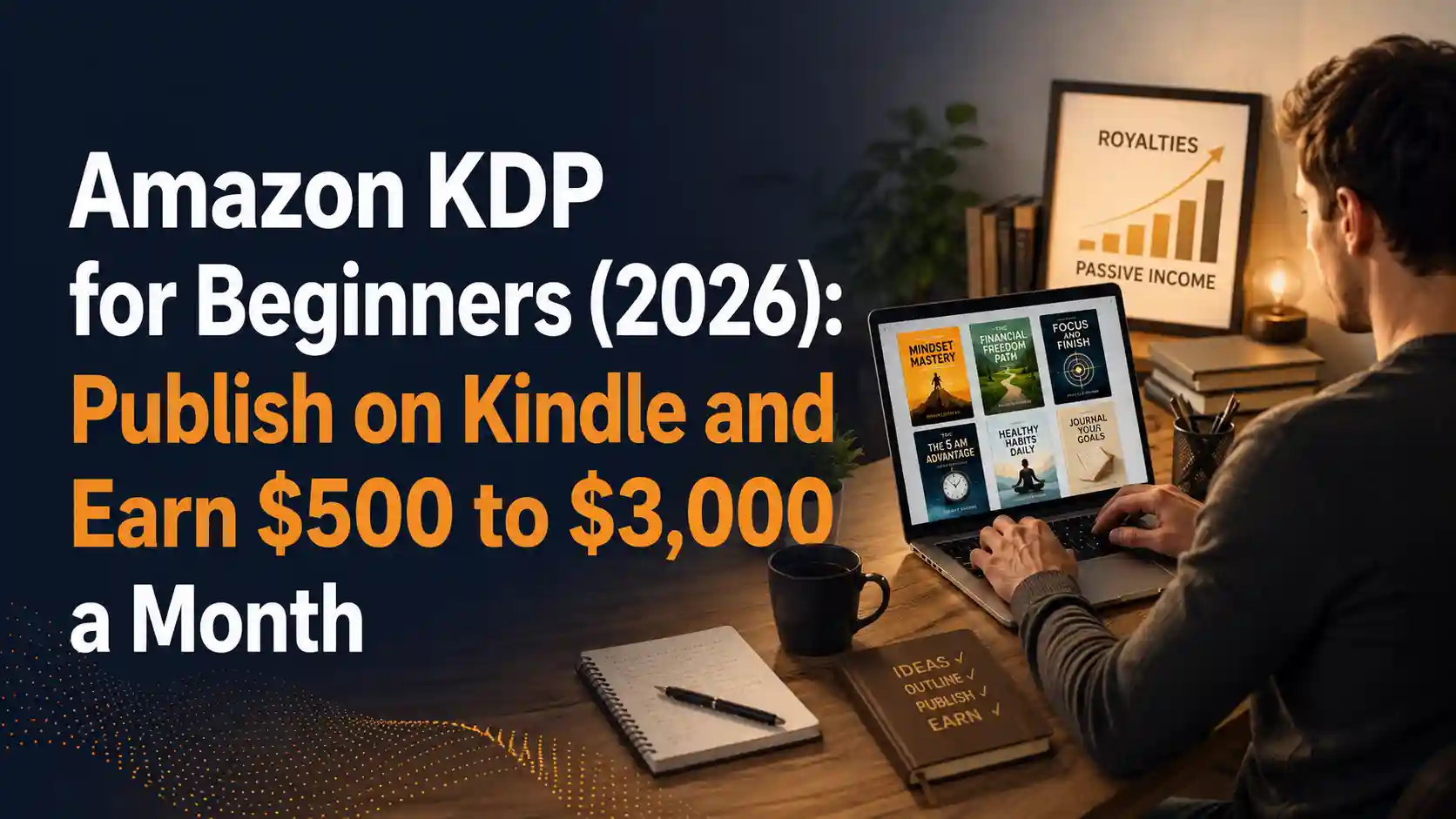
Amazon KDP has turned everyday people into published authors and quiet earners, all from a laptop at the kitchen table.
You upload a book, Amazon prints or delivers it, and you collect a royalty every time someone buys. No agent, no warehouse, no upfront cost.
That mix of zero startup money and worldwide reach is why so many beginners start here.
This guide walks you through how Amazon KDP works, the real royalty numbers, how to publish on Kindle step by step, and the low content books and KDP niches that still sell in 2026.
Uncover My Top Recommendation for Making $300-$500 Daily – Check Out This FREE Video to Begin >>>
What Is Amazon KDP?
Amazon KDP (Kindle Direct Publishing) is Amazon’s free self-publishing platform.
You upload your book, set your own price, and Amazon handles the printing, delivery, and payment. You keep a royalty on every copy sold.
You can publish several formats:
- Ebooks that people read on Kindle apps and devices
- Paperbacks printed only when someone orders, so you hold no stock
- Hardcovers for a premium feel
- Low content books like journals, planners, and puzzle books
The reach is huge. KDP powers roughly 70% to 75% of the US ebook market, and in May 2026 alone, Amazon paid KDP Select authors $70.3 million, according to its own dashboard. That is a lot of money moving to regular self-publishers.
How Amazon KDP Royalties Work (The Real Numbers)
Here is the part beginners care about most: the money. Amazon KDP pays two main royalty rates, and small pricing choices change your take-home a lot.
- Ebooks earn 70% when priced between $2.99 and $9.99, and 35% at any price outside that band. At 70%, a $4.99 ebook nets about $3.45 after a tiny $0.15-per-MB delivery fee.
- Paperbacks earn 60% of list price minus printing, but only at $9.99 and above. Amazon’s June 2025 change drops that to 50% for paperbacks priced below $9.99. A $12.99 paperback nets roughly $4 after print costs.
- Kindle Unlimited pays per page read instead of per sale, at about $0.004 to $0.005 a page, funded from a monthly pool.
The 70% ebook rate applies in 13 territories, including the US, UK, Canada, Australia, Germany, France, Japan, and India. Amazon pays you about 60 days after the month of sale.
KDP for Beginners: How to Publish on Kindle Step by Step
Ready to publish on Kindle? The whole setup is simpler than most people expect. Here is the path from idea to live listing.
- Create a free KDP account at kdp.amazon.com and add your tax and bank details.
- Pick a book type and niche you can produce well.
- Build your interior using Canva, Book Bolt, or a written manuscript.
- Design a cover that grabs attention as a small thumbnail in search.
- Upload your files and fill in the title, keywords, and categories.
- Set your price, aiming for $2.99 to $9.99 on ebooks and $6.99 to $14.99 on low content paperbacks.
- Hit publish. Your book usually goes live within 24 to 72 hours.
That’s it. Your first title can be selling to a global audience by this time tomorrow.
Low Content Books: The Easiest Way to Start
Low content books are books with very little text inside, such as journals, planners, trackers, notebooks, and puzzle books.
You sell the format and the usefulness, not the writing, which makes them the friendliest on-ramp for beginners.
Why they work so well for newcomers:
- Free design tools. Canva and Book Bolt hand you ready-made interior templates.
- Fast to make. A single low content book can go from idea to live in 2 to 4 hours.
- Real income. Individual titles often earn $20 to $300 a month, and publishers with catalogs of 50 to 100 titles report $500 to $3,000 a month (Merch Titans and Vappingo data).
One warning for 2026: Amazon tightened its quality checks across 2025 and 2026. Copy-paste and near-identical books now get removed or buried.
The old game of uploading 500 generic notebooks is dead. Make each book specific, useful, and worth buying.
Uncover My Top Recommendation for Making $300-$500 Daily – Check Out This FREE Video to Begin >>>
Best KDP Niches for 2026
Picking the right niche is still the biggest factor in Amazon KDP success. The winning formula this year is simple: broad category plus specific audience plus clear benefit.
A “puzzle book” competes with millions, while a “large-print word search for memory care residents” competes with a handful.
Here are the KDP niches selling in 2026:
- Bold and easy coloring books. Thick outlines and simple designs suit older adults, beginners, and kids. The 8.5 x 8.5 square format stands out on Amazon.
- Large-print puzzle books for seniors. Word search, sudoku, and crosswords for the growing 65-plus market stay underserved.
- Niche guided journals. Think “anxiety journal for teens” or “sobriety tracker,” not a plain lined journal.
- Caregiver and medical logs. Medication trackers and symptom journals for people caring for aging or ill family members.
- Profession-specific planners. Teacher lesson planners, nurse notebooks, and real estate trackers command $9.99 to $14.99 because they solve a real workflow.
- Memory and keepsake journals. Giftable titles that sell hard around Mother’s Day, Christmas, and baby season.
- Password log books. Simple, always in demand, and quick to design.
- Hobby micro-niches. Birdwatching logs, fishing journals, and gardening planners attract loyal, repeat buyers.
Common Mistakes to Avoid
Steer clear of these and you skip the pain most beginners hit:
- Publishing generic copies. Amazon now removes duplicate interiors. Make yours original.
- Pricing paperbacks below $9.99. That knocks you from 60% down to a 50% royalty.
- Skipping niche research. Guessing wastes weeks. Check demand before you design.
- A weak cover. If the thumbnail flops, the sale is gone. Study bestsellers and match the quality.
- Quitting after 5 books. KDP rewards a catalog. The results compound as your library grows.
Pro Tips to Earn More on Amazon KDP
Ready to grow past your first title? These moves stack the odds in your favor:
- Publish series, not singles. Related titles feed Amazon’s “Also Bought” loop and lift each other.
- Guard the 70% band. Keep ebooks between $2.99 and $9.99 so you never slip to 35%.
- Trim your ebook file. A smaller file means a smaller delivery fee and more royalty per sale.
- Own your keywords and categories. Fill all 7 keyword slots and pick tight subcategories where you can rank.
- Niche down hard. The narrower the audience, the less competition and the better your price holds.
Frequently Asked Questions
Is Amazon KDP free to use?
Yes. Uploading and publishing on KDP costs nothing. You only pay if you choose extras like your own ISBN or paid editing and design. Amazon takes its cut only when a book sells.
How much do KDP authors earn?
It varies widely. Ebook authors earn about $2 to $7 per sale, and low content titles often bring in $20 to $300 a month each. Publishers with 50-plus books report $500 to $3,000 a month.
What are low content books?
Low content books have minimal text inside, like journals, planners, trackers, notebooks, and puzzle books. You sell the useful format rather than written content, which makes them fast to create.
Do I need writing skills to publish on KDP?
Not for low content books. Free tools like Canva and Book Bolt provide templates, so the main skill is niche research and clean cover design. Written books need writing, of course.
What are the best KDP niches in 2026?
Bold and easy coloring books, large-print puzzles for seniors, niche guided journals, caregiver logs, and profession-specific planners all sell well. Specificity beats broad topics every time.
How long does it take to publish on Kindle?
A low content book can go from idea to finished files in 2 to 4 hours. After you upload, Amazon usually makes it live within 24 to 72 hours.
How do I get the 70% ebook royalty?
Price your ebook between $2.99 and $9.99 and make it available in the eligible territories. Anything outside that price range earns the 35% rate.
Uncover My Top Recommendation for Making $300-$500 Daily – Check Out This FREE Video to Begin >>>
Ready to Publish Your First KDP Book?
You now know how Amazon KDP works, what the royalties really pay, how to publish on Kindle, and which low content books and KDP niches are moving in 2026.
The barrier to entry is basically zero, and the market rewards people who pick a smart niche and keep building.
Your next step: open a free KDP account today, pick one specific niche from the list above, and design your first low content book this weekend. Your first royalty is one upload away, so start now and let your catalog grow while you sleep.