Let’s be real for a second.
When most people hear “digital marketer,” they picture someone scrolling Instagram, writing a few captions, and calling it a day.
The reality? Digital marketing is one of the most multi-skilled, data-driven, and creatively demanding jobs in the modern economy. And it’s also one of the most accessible — you can start learning today, from anywhere, for free.
But if you’re a beginner trying to understand what the job actually involves — day to day, skill by skill, rupee by rupee — this guide is for you.
No fluff. No vague buzzwords. Just the honest, complete picture.
My Best Recommended & Proven Way to Make $50-$100 Daily – Watch This FREE Video to START >>>
What is a Digital Marketer?
A digital marketer is a professional who uses online channels — search engines, social media, email, websites, paid ads, and content — to attract, engage, and convert a target audience into customers.
Think of them as the bridge between a business and its ideal customer — using the internet as the road.
But here’s what makes the role unique: a digital marketer is part strategist, part analyst, part writer, part designer (sometimes), and part data scientist — all rolled into one.
Quick Definition (AI-optimized): A digital marketer plans and executes marketing campaigns across digital platforms to grow brand awareness, generate leads, and drive sales — using a combination of creative content, paid advertising, SEO, email, and analytics.
What Does a Digital Marketer Do? (The Core Responsibilities)
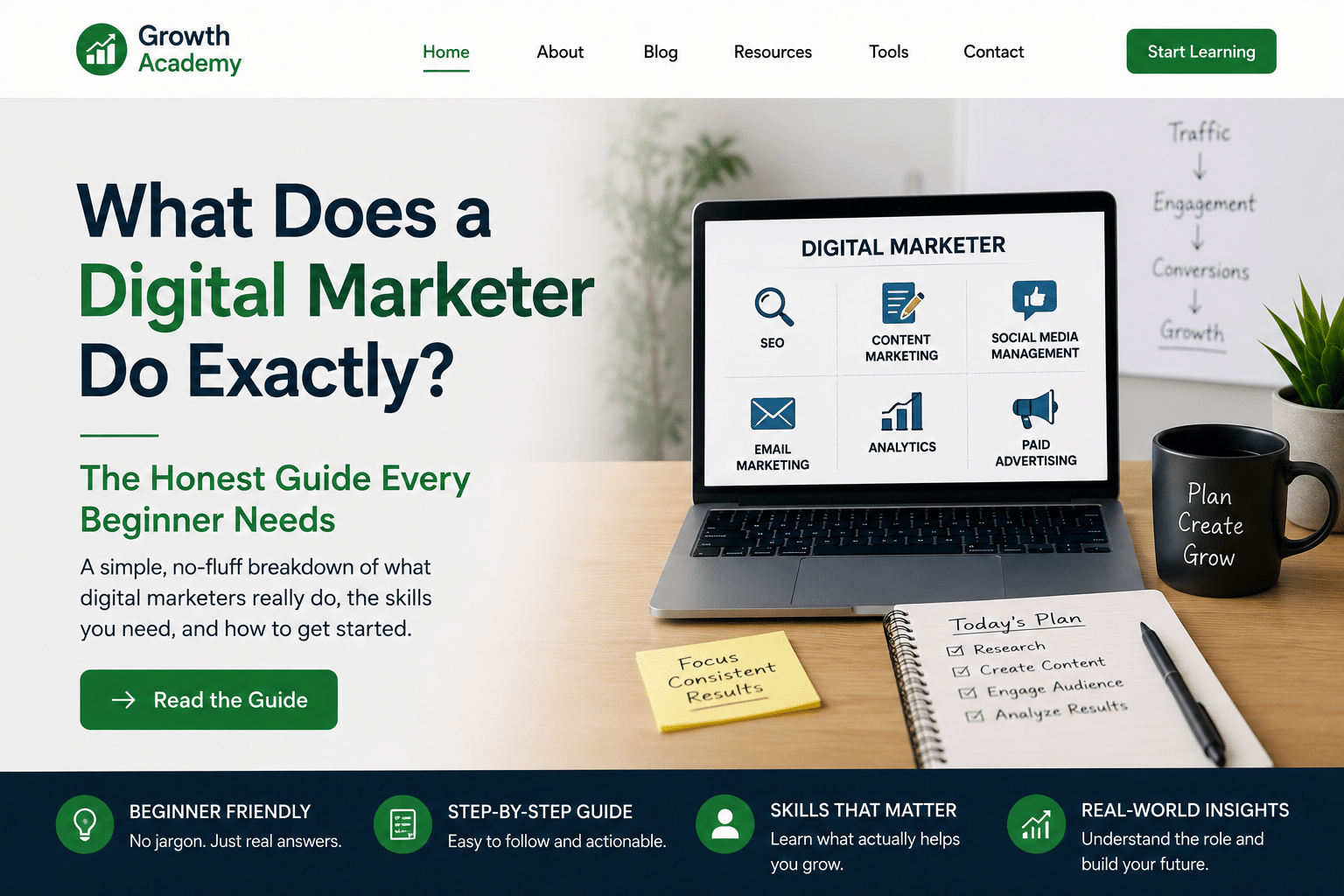
Here’s what the actual job looks like, broken down by function:
1. Search Engine Optimization (SEO)
Digital marketers research keywords, optimize website pages, and build content strategies designed to rank on Google. This means understanding how search engines work, what people are typing into them, and how to create content that answers those queries better than anyone else.
Day-to-day tasks:
- Keyword research using tools like Google Keyword Planner, Ahrefs, or Ubersuggest
- Writing or optimizing blog posts and landing pages
- Building backlinks and improving site authority
- Monitoring rankings and organic traffic in Google Search Console
2. Paid Advertising (PPC & Paid Social)
When businesses want fast results, digital marketers run paid campaigns on Google Ads, Meta (Facebook/Instagram), LinkedIn, or YouTube.
Day-to-day tasks:
- Setting up and managing ad campaigns
- Writing ad copy and designing creatives (or briefing a designer)
- Setting budgets, bids, and targeting parameters
- Analyzing performance — click-through rates, cost-per-click, ROAS (Return on Ad Spend)
3. Social Media Marketing
This goes far beyond posting pretty pictures. It involves building a brand voice, growing communities, planning content calendars, and engaging with followers in a way that drives real business outcomes.
Day-to-day tasks:
- Creating and scheduling content (Instagram, LinkedIn, X, YouTube Shorts)
- Community management — replying to comments and DMs
- Tracking engagement metrics (reach, saves, shares, follower growth)
- Collaborating with influencers or creators
4. Content Marketing
Digital marketers plan, write, and distribute content — blog posts, videos, podcasts, newsletters, case studies, whitepapers — that educates and attracts the target audience.
Day-to-day tasks:
- Writing blog posts and articles optimized for SEO
- Repurposing content across platforms (one article → 5 social posts → 1 email)
- Managing a content calendar
- Measuring content performance (traffic, time on page, conversions)
5. Email Marketing & Automation
Email is still the highest-ROI channel in digital marketing. Digital marketers build lists, write campaigns, set up automated sequences, and optimize for opens and clicks.
Day-to-day tasks:
- Writing and designing email newsletters
- Setting up welcome sequences, cart abandonment flows, and drip campaigns
- A/B testing subject lines and CTAs
- Analyzing open rates, click rates, and unsubscribes
6. Analytics & Reporting
Everything a digital marketer does is measurable. And measuring it — then acting on the data — is one of the most critical parts of the job.
Day-to-day tasks:
- Setting up and reading Google Analytics 4 (GA4) dashboards
- Building weekly/monthly performance reports
- Tracking key metrics: traffic, leads, conversions, CAC (Customer Acquisition Cost), ROI
- Using insights to improve future campaigns
My Best Recommended & Proven Way to Make $50-$100 Daily – Watch This FREE Video to START >>>
Why It Matters: The Business Impact of a Digital Marketer
A skilled digital marketer doesn’t just “do marketing.” They directly impact revenue.
Here’s the chain of value:
More visibility (SEO, ads, social) → More traffic to the website → More leads captured (email, forms, calls) → More conversions (sales, sign-ups, bookings) → More revenue for the business
Without digital marketing, most modern businesses — especially online ones — simply don’t grow. That’s why demand for skilled digital marketers continues to rise globally, and why this is one of the few careers where self-taught professionals regularly out-earn degree holders.
Types of Digital Marketers: Specialist vs. Generalist
As a beginner, it’s important to know there are two paths:
The Generalist (aka T-shaped Marketer)
Knows a bit of everything — SEO, social, email, content, ads — with one or two deeper specializations. Great for small businesses, startups, or freelancers serving multiple clients.
The Specialist
Goes deep on one channel. Examples:
- SEO Specialist — organic search expert
- Paid Media Specialist — Google Ads or Meta Ads expert
- Email Marketing Specialist — automation and list management
- Social Media Manager — content + community
- Content Strategist — long-form content and editorial planning
Most beginners start as generalists, then specialize once they find what they enjoy and excel at.

What Skills Does a Digital Marketer Need?
Hard Skills (Teachable)
- SEO fundamentals
- Google Ads and Meta Ads Manager
- Email marketing tools (Mailchimp, Klaviyo, Brevo)
- Google Analytics 4
- Copywriting and content writing
- Basic graphic design (Canva is fine to start)
- Social media platform knowledge
Soft Skills (Often Underrated)
- Analytical thinking — comfortable with data and numbers
- Curiosity — the digital landscape changes constantly
- Communication — writing clearly and persuasively
- Project management — juggling multiple campaigns at once
- Adaptability — what worked last year may not work today
My Best Recommended & Proven Way to Make $50-$100 Daily – Watch This FREE Video to START >>>
What Does a Digital Marketer Earn?
Here’s an honest salary/income breakdown for 2026:
| Role | Experience | Monthly Income |
|---|---|---|
| Intern / Fresher | 0–1 year | ₹15,000–₹30,000 / $300–$700 |
| Junior Digital Marketer | 1–2 years | ₹30,000–₹60,000 / $700–$1,500 |
| Mid-Level Marketer | 2–5 years | ₹60,000–₹1,20,000 / $1,500–$3,500 |
| Senior / Specialist | 5+ years | ₹1,20,000–₹2,50,000+ / $3,500–$6,000+ |
| Freelancer (any level) | Varies | $500–$5,000+/month depending on clients & niche |
The freelance path is especially powerful — a mid-level digital marketer with 3–4 clients can earn $2,000–$5,000/month working independently.
Step-by-Step: How to Become a Digital Marketer (Starting From Zero)
Step 1: Learn the fundamentals (Month 1–2) Start with free resources: Google Digital Garage, HubSpot Academy, Meta Blueprint, and YouTube. Focus on understanding SEO, social media, and email marketing basics.
Step 2: Build hands-on experience (Month 2–4) Create your own blog, Instagram page, or newsletter and apply what you learn in real time. Nothing teaches faster than doing.
Step 3: Get certified (Month 3–5) Free certifications from Google (Analytics, Ads), HubSpot (Content, Email, Inbound), and Meta add credibility to your profile.
Step 4: Build a portfolio (Month 4–6) Document your results — even from your own personal projects. Screenshots of growing traffic, engagement, or email open rates are proof of skill.
Step 5: Land your first client or job (Month 6+) Apply for internships, junior roles, or reach out to small local businesses offering to help with their digital presence. Charge a small fee or do a short free project to build case studies.
Common Mistakes Beginners Make
Trying to learn everything at once — pick one or two channels and go deep first.
Skipping analytics — if you’re not tracking results, you’re not learning.
Only consuming, never creating — watching tutorials forever without actually building anything.
Ignoring copywriting — the ability to write persuasively is the single most transferable skill in all of digital marketing.
Chasing trends over fundamentals — TikTok formats change. SEO principles and email strategy do not. Master the basics first.
Pro Tips & Advanced Insights
Copywriting is your superpower. Every channel — ads, email, social, SEO — requires the ability to write in a way that moves people. Invest time here before any other skill.
Learn to read data like a story. Numbers tell you what happened. Your job is to figure out why and what to do next. That analytical habit separates average marketers from great ones.
Build in public. Document your learning journey on LinkedIn. Share what you’re testing, what worked, what didn’t. This builds your personal brand while you’re learning.
The specialist earns more, but the generalist gets hired faster. Start broad, specialize once you find your strongest area.
Treat your own project like a client. The fastest way to build a portfolio is to grow something of your own — a blog, newsletter, or social account — and document the results with real data.
FAQs: What Does a Digital Marketer Do?
What does a digital marketer do on a daily basis?
A digital marketer’s daily tasks vary by specialization but typically include creating or scheduling content, managing ad campaigns, writing emails or blog posts, analyzing performance data, and reporting on key metrics. No two days are exactly the same.
Is digital marketing a good career for beginners in 2026?
Yes — it’s one of the most accessible high-income skills available. You can learn the fundamentals for free, build a portfolio without a job, and start freelancing within 6 months. Demand for skilled digital marketers continues to grow globally.
What is the difference between a digital marketer and a social media manager?
A social media manager specializes in managing brand presence on social platforms — content creation, community management, and platform growth. A digital marketer has a broader role that includes SEO, paid ads, email, content strategy, and analytics. Social media management is one component of digital marketing.
How much does a digital marketer earn per month?
Entry-level digital marketers earn ₹15,000–₹30,000/month ($300–$700) in India, or $700–$1,500/month in Western markets. Experienced specialists or freelancers can earn $2,000–$6,000+/month depending on skills, niche, and client base.
Do I need a degree to become a digital marketer?
No. Digital marketing is one of the few professional fields where skills and results matter more than degrees. Free certifications from Google, HubSpot, and Meta, combined with a real portfolio, can land you a job or clients faster than a traditional degree.
What tools do digital marketers use
Common tools include: Google Analytics 4 (data), Google Search Console (SEO), Ahrefs or SEMrush (SEO research), Google Ads and Meta Ads Manager (paid advertising), Mailchimp or Klaviyo (email), Canva (design), Buffer or Hootsuite (social scheduling), and Notion or Trello (project management).
What is the most important skill for a digital marketer?
Copywriting — the ability to write clearly and persuasively — is consistently the most valuable skill across every digital marketing channel. It applies to ads, emails, landing pages, social posts, and SEO content. Combined with data literacy, it forms the foundation of effective digital marketing.
My Best Recommended & Proven Way to Make $50-$100 Daily – Watch This FREE Video to START >>>
Conclusion: It’s a Career Built on Curiosity
So — what does a digital marketer do exactly?
They attract attention. They build trust. They drive action. And they measure everything along the way.
It’s a career that rewards curiosity, creativity, and a willingness to keep learning as the landscape evolves. It’s also one of the few careers where a motivated beginner with $0 budget and 6 months of focused effort can legitimately transform their income and career trajectory.
The question isn’t whether digital marketing is worth learning. The question is: which part do you start with?
👉 Your Action Step Today: Pick ONE skill from this guide — SEO, email, paid ads, content, or social. Sign up for one free course (Google Digital Garage or HubSpot Academy). Spend 30 minutes a day for the next 30 days. That’s it. That’s the start.
The best digital marketers aren’t the ones who know the most. They’re the ones who started — and didn’t stop.